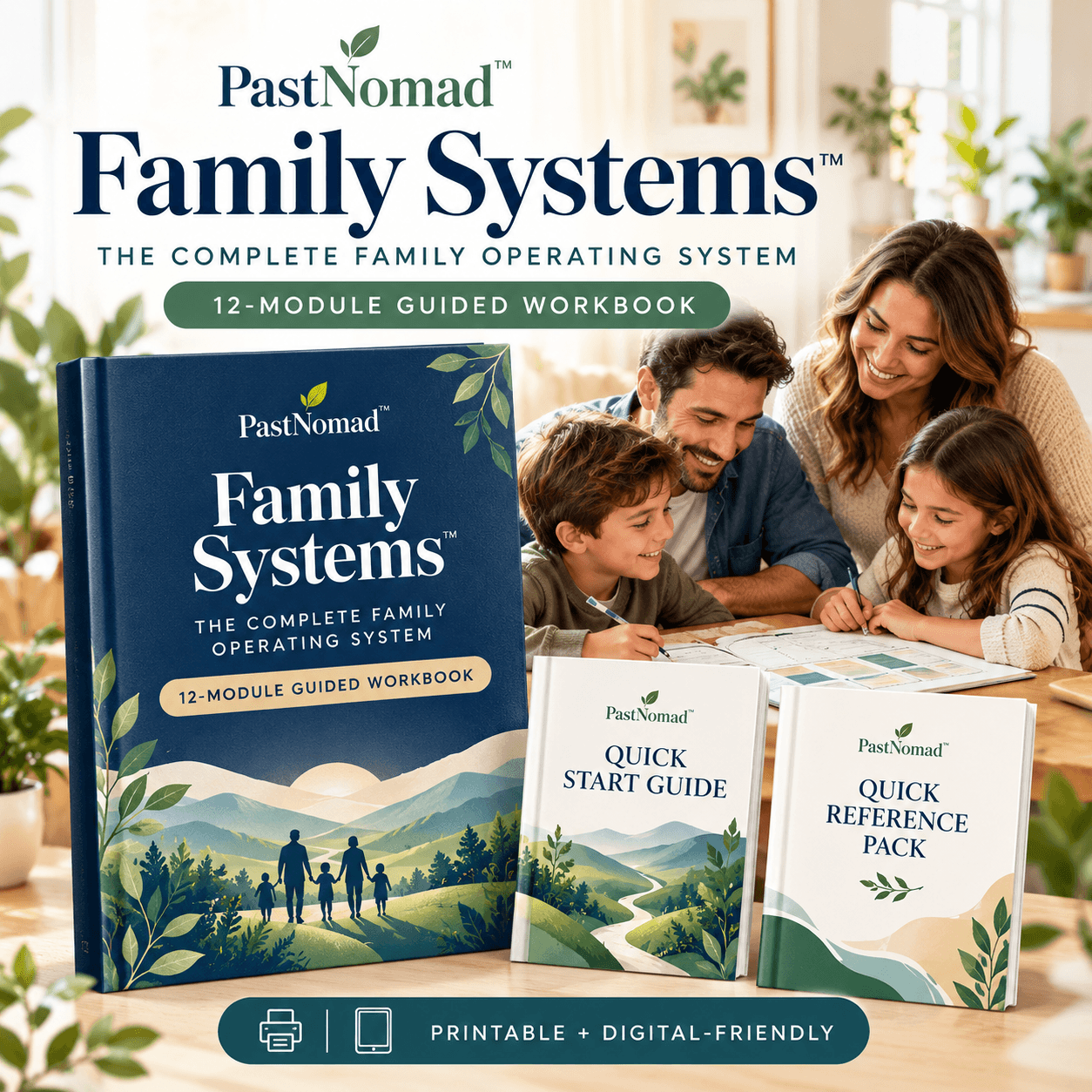
A guided 12-module framework for families with children ages 3–15. Build more workable routines, share responsibilities, make thoughtful screen-time agreements, and plan together—one small step at a time.
You don't need to become a perfect parent.
You need family systems that make everyday life easier to navigate.
Most family friction isn't a parenting failure. It's a systems problem — unclear ownership, no shared plan, routines that break under real-world pressure, and tools that don't flex with a changing family.

Family life rarely follows a perfect plan. A shared routine gives everyone a clearer place to start—without expecting every day to go exactly right.
Use simple tools to make schedules visible, clarify responsibilities, and create more calm around everyday transitions.
Every module in the system follows the same six-step rhythm — so families always know what to do next.
Twelve focused modules. Reflection prompts, decision tools, family conversations, and reusable worksheets for each one.
Clarify who your family is and what you actually want to stand for.
Translate shared values into the family life you're actually building.
Build the everyday habits that keep family members feeling heard and close.
Design mornings, meals, homework, and wind-downs that don't fall apart by Wednesday.
Make ownership visible so the mental load doesn't fall on one person.
Care for the family's collective energy, rest, and ability to bounce back.
Spot when a system is no longer working and rebuild it on purpose.
Handle friction, repair after hard moments, and solve problems as a team.
Build a workable, non-judgmental approach to screens, devices, and online life.
Treat learning as a shared family practice, not just a school task.
Plan for what's ahead — new stages, transitions, and shifting needs.
Make reflection a rhythm so the system keeps working as life changes.
The modules flow into each other — but you can also jump directly to the area that matters most right now.
Use it sequentially as a guided journey, or open the module that matches the friction you're feeling this week.
You can begin with the part of family life that needs attention now—then adapt as you learn what works.
Traditional planners tell families what to schedule. PastNomad helps families think more clearly about how their life actually works.
No promises of perfect families — just clearer priorities and systems you can actually use.
PastNomad is for parents and caregivers who want practical systems, not parenting theory.
Most sessions take 10–20 minutes. You don't need to finish a module to benefit from it.
Choose where your family needs the most help right now.
Work through one conversation, decision, or worksheet at a time.
Try one small system, routine, or agreement for the week.
Keep what works. Change what doesn't. Move to the next module.
Designed for busy families — flexible enough to use on a Sunday evening or a 15-minute window after dinner.
Alongside the 90-page core system, these companion resources help you begin, put ideas into practice and return to the tools you use most.
Choose one realistic starting point and follow a simple first-week path without feeling you have to change everything at once.
Keep family meeting prompts, daily rhythms, screen agreements, reset plans and 90-day planning references close at hand.
US Letter worksheets for weekly planning, routines, responsibilities, meals, school logistics, caregiver handoffs, reflection and a 30-day rollout.
Plan weekly rhythms, routines, chores, household essentials and handoffs in a local browser tool. Save a JSON backup when you need to preserve or move your entries; it does not sync between devices.
A brief tour of the bundle and a simple recommended path to help you take the first useful step.
Simple directions for opening the HTML planner, saving work, exporting and restoring backups, and printing.
PastNomad is grounded in thoughtful design and the realities of family life — not promises no program can keep.
Built around how families actually live, work, and change.
Clear worksheets, gentle prompts, and a calm editorial feel.
Use what fits. Adapt it. Skip what doesn't. There is no "right" way.
A few things families ask before getting started.
PastNomad is built for families with children approximately ages 3–15. Most of the work is done by the adults in the home; children participate at the level that fits their age.
It's a guided family operating system. It includes workbook elements (reflection prompts, worksheets, decision tools) and reusable planning tools — but it goes beyond a typical planner by helping you build the systems behind your routines.
Yes. The system is designed to be flexible. You can work through the modules in order, or jump straight to the area that matters most to your family right now.
Where it makes sense — yes. Many modules include family conversations and prompts that work well for older children, while others (like the responsibility and screen modules) are mainly adult-led. Use your judgment.
Yes. The 21-page Command Center workbook is formatted for US Letter printing. The guide and reference PDFs can also be printed as needed. Print only the pages you want to reuse, or keep them in a binder.
The PDFs can be viewed on a phone, tablet or computer, and you may annotate them in a compatible PDF app. The separate Interactive Family Command Center is an HTML tool that runs in a supported browser and stores entries locally on that device. It does not offer cloud syncing or automatic cloud backups; use its manual JSON export and restore options to keep or move a backup.
Most sessions are 10–20 minutes. You don't need to finish a module to benefit — even a single conversation prompt can shift how your family operates.
No. PastNomad is designed to be a living system, not a course. Use the parts that matter, adapt them, and come back when life changes.
No. PastNomad is a practical family system. It is not therapy, treatment, clinical intervention, or medical or psychological advice. If your family needs professional support, please reach out to a qualified professional.
Your bundle includes the 90-page, 12-module core guide; 6-page Quick Start Guide; 6-page Quick Reference Pack; 21-page printable Command Center workbook; Interactive Family Command Center HTML planner; 2-page Start Here guide; and Interactive Tool Instructions. All items are digital files.
After checkout, follow the digital-download instructions provided with your purchase. Open the Start Here guide first; it explains the files and the easiest way to begin. Keep a copy of your downloaded files and make manual backups of any planner entries you want to preserve.
Start with what matters most. Make one part of family life easier. Build from there.
Build calmer routines. Share the load. Stay connected. Adapt as life changes.
Get Instant Access — $29